
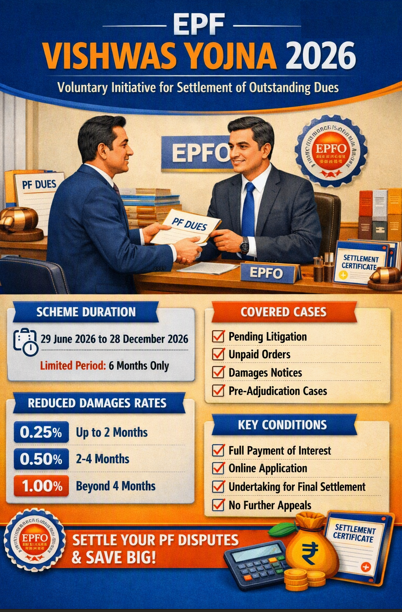
EPFO has launched VISHWAS, 2026, a special scheme that helps employers settle old PF damages cases (late payment penalties) at much lower rates.
It covers cases under:
- Section 14B of the EPF Act, 1952
- Section 128 of the Code on Social Security, 2020
EPFO’s circular dated 9 July 2026 explains who can apply, how damages will be reduced, and the step-by-step online process.
If there is any old PF damages notices, pending recovery, or litigation, this scheme gives a chance to close everything at a reasonable cost.
Scheme Duration
- Start Date: 29 June 2026
- End Date: 28 December 2026 (six months from notification)
Since reconciling old PF records takes time, employers should start reviewing their cases as early as possible.
Which Cases Are Covered?
VISHWAS, 2026 applies to four types of cases:
| Category | Meaning |
| Ongoing litigation | Damages orders already challenged in court/tribunal |
| Finalised orders | Damages orders issued but unpaid or partly paid |
| Notice issued | Damages notice received but final order not passed |
| Notice not issued | Eligible defaults where EPFO has not yet started damages proceedings |
This means the scheme is useful even if no final order has been issued yet.
Reduced Damages Rates
For PF delays before 14 June 2024, damages will be charged at much lower rates:
| Delay Period | Damages per month |
| Up to 2 months | 0.25% |
| 2–4 months | 0.50% |
| More than 4 months | 1.00% |
These rates are far lower than the usual slabs, so employers may save a significant amount.
Actual savings depend on:
- How long the delay was
- What was paid earlier
- Interest payable
- Whether litigation is pending
Interest Payment Is Mandatory
To get reduced damages, employers must first pay full interest under:
- Section 7Q (EPF Act), or
- Section 127 (Code on Social Security)
Before applying, employers should prepare a month-wise PF delay sheet showing:
- Due date
- Actual payment date
- Delay period
- Interest payable
- Interest already paid
- Balance interest
Proof of interest payment must be uploaded with the application.
Settlement = Final Closure
Once Company opt for VISHWAS, 2026:
- You must give an undertaking that no further appeal will be filed.
- For cases already in court, you must take steps to withdraw or close the case.
Before applying, employers should compare:
- Revised damages under VISHWAS
- Strength of their legal case
- Amount already paid
- Cost of continuing litigation
- Benefit of final closure
Treatment of Amounts Already Paid
- If you have paid less than the revised damages → you must pay the balance.
- If you have paid more → no refund will be given.
- Pre-deposits made during appeal will be adjusted as per scheme rules.
Cases Not Eligible
The scheme does not apply to:
- Cases where damages are already fully recovered
- Cases involving fraud or deliberate manipulation
- Cases where interest is not fully paid
VISHWAS is meant for genuine PF delays, not intentional violations.
Online Application Process (Simple Steps)
Applications must be filed on the EPFO Employer Portal.
Employers will need to:
- Select the correct case category
- Enter default period and order/notice details
- Provide damages levied and paid
- Upload interest payment proof
- Submit declarations and undertaking
- Sign using DSC/e‑sign
EPFO will verify the application and may:
- Approve
- Reject
- Return for clarification
Once approved, payment must be made within 15 days.
Important: Once a challan is generated, it cannot be cancelled. So employers must check calculations carefully.
After payment, EPFO will issue a digitally signed settlement certificate on the portal.
The EPF VISHWAS Scheme 2026 is a valuable chance to settle long-pending PF damages at much lower rates and close disputes permanently.
But the benefit depends on:
- Full interest payment
- Correct documentation
- Timely application
- Withdrawal of litigation
Employers should review eligible cases quickly and complete the process within the scheme period.
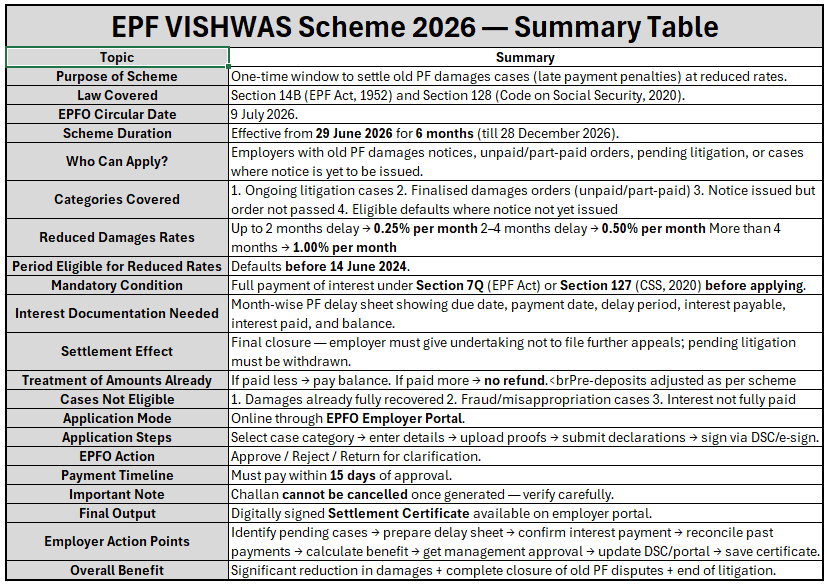
Notification : Vishwas